Why Independent Stores Need a Product Knowledge File for AI Shopping
v1.0.0 features
A practical explanation of why an independent store needs a small, source-aware knowledge entry point alongside product pages, feeds, and checkout systems.
Status: This article reflects the current v1.0.0-beta boundary. It reports a method and its evidence requirements, not unverified adoption, ranking, citation, recommendation, or sales outcomes.
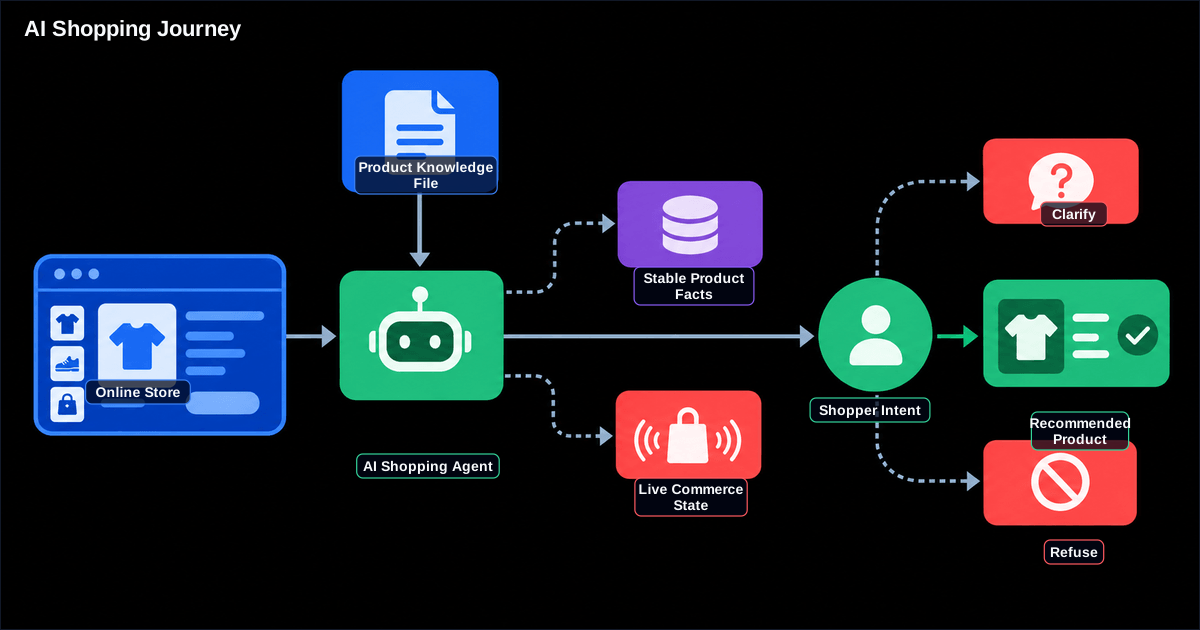
A shopper landing on a product detail page has already crossed several bridges: they know the store, can see a product, and are willing to inspect it. An AI shopping agent often starts earlier, with a sentence such as “find a carry-on that fits a two-day trip and avoids animal leather.” It must turn that request into constraints, find candidates across a catalog, and explain why one candidate fits. A page designed to sell one item is useful evidence, but it is a poor catalog-level index.
That gap is where a product knowledge file earns its place. It gives an independent store one merchant-controlled entry point for stable product meaning. It does not replace the page, feed, or checkout. It makes those systems easier to reach and harder to confuse.
The journey starts before the product page
People browse visually. They infer hierarchy from photos, tabs, badges, accordions, and nearby recommendations. An agent must first discover which resources are authoritative, then extract comparable facts without treating navigation text or a campaign banner as product truth. The cost is highest for an independent store because its catalog is less likely to have a platform-specific connector.
A compact catalog document changes the first step. It can identify the merchant, enumerate product knowledge documents, and point back to public product pages. The agent still reads those pages when needed; it simply begins with a map published by the merchant instead of guessing the map from a crawl.
One file should answer bounded questions
The file should make six things easy to establish: what the product is, which use cases it suits, where it does not fit, what it is compatible with, how it is identified, and which public source supports each claim. These are stable enough to review and version. They are also the facts most likely to decide whether a recommendation is appropriate.
The boundary matters. A product knowledge file should not state that an item is available “now,” quote a live delivery date, or decide whether checkout can succeed. Those answers can change between retrieval and purchase. The agent must hand them to the commerce system at decision time.
Merchant control changes the evidence chain
Structured data embedded in a page, a marketplace listing, and a merchant feed can all describe the same item differently. A merchant-controlled knowledge document supplies an explicit source URL and update date for each important statement. That does not make every statement correct, but it makes disagreement visible and correctable.
For a small team, the practical advantage is editorial. The same file can be reviewed in a pull request, compared between versions, and regenerated from approved store data. When a limitation changes, the merchant can update one bounded statement rather than hoping every downstream system infers the change from revised promotional copy.
A simple operating model for an independent store
Start with a narrow catalog, preferably products whose suitability depends on compatibility or limitations. Publish a root document and one product knowledge document per selected item. Validate the public bytes, retain the source links, and test a fixed set of shopper questions. Each answer should reveal which fact produced the match and where live information must be checked.
| Question in the journey | Best authority |
|---|---|
| What is this product and who is it for? | Source-backed product knowledge |
| Which model or variant is this? | Identifiers and product page |
| Is it in stock at this moment? | Store or inventory service |
| What will I pay and when will it arrive? | Offer, shipping, and checkout systems |
Measure retrieval quality, not marketing outcomes
The first useful metrics are modest: can a consumer discover the catalog, retrieve the correct product document, preserve its sources, and reject an incompatible candidate? A merchant can run those checks with known questions and expected facts. Referral traffic may be observed later, but it does not establish that the file caused a ranking, citation, recommendation, or sale.
The decision to publish is therefore an information-quality decision. If the store can maintain stable claims, limitations, identifiers, and sources more reliably than agents can reconstruct them from presentation pages, a product knowledge file is worth testing.
A two-week starting checklist
- Choose five to twenty products with clear comparison questions.
- Record facts, guidance, limitations, compatibility, identifiers, and sources.
- Keep current price, inventory, delivery promises, and checkout state out.
- Publish under the merchant’s control and validate the actual public response.
- Test the same shopper questions before and after adding the knowledge file.
- Log missing evidence and refusals as carefully as successful matches.
Walk through one recommendation request
Consider a store that sells travel bags. A shopper asks for a carry-on for a two-day work trip, suitable for a 14-inch laptop, without animal leather. The agent needs more than a product name. It must identify capacity and dimensions, distinguish material from marketing language, check the laptop compartment, and exclude products whose trim uses leather. A catalog entry can point to the candidate documents; each product document can state the relevant facts, limitation, and source. Availability and the final delivered price remain questions for the live store.
This example also exposes why a single prose answer is insufficient. “Good for business travel” is guidance, while “the padded sleeve fits devices up to 14 inches” is a checkable compatibility claim. “Vegan” may be a certification claim that requires a source, while “no animal-derived leather is listed in the bill of materials” is narrower. Keeping those statements separate lets the consumer match the request without silently strengthening the merchant’s evidence.
Assign an owner to every kind of truth
A useful implementation starts with an authority map. The merchandising team may own intended use and approved limitations. Product operations may own dimensions, materials, and identifiers. The storefront or commerce API owns current offers, inventory, taxes, and fulfillment promises. Legal or compliance owners may need to approve safety and certification language. The knowledge document should publish only the stable statements that those owners can defend from public evidence.
The map prevents a common maintenance failure: copying a live value into a static file because it was easy to retrieve during generation. A generator can read many systems, but it should emit only fields within the knowledge boundary. If a source record changes, the workflow should identify the affected statement, request review when needed, publish atomically, and retain the previous revision for comparison.
What a small pilot should record
For every test question, preserve the question text, the catalog and product documents retrieved, the source URLs consulted, the selected candidate, excluded candidates, and the reason for the decision. Also record whether the request required a live handoff. This creates an audit trail that a second implementation can inspect instead of a screenshot of a persuasive answer.
The pilot should contain difficult cases: two products with similar names, a variant-specific compatibility constraint, an explicit “not for” condition, a missing fact, and a request that depends on stock or delivery time. A useful result is not always a recommendation. Correctly declining to answer, or handing the shopper to a live system, is part of the quality target.