From “Help Me Choose” to a Product Recommendation: How AI Agents Interpret Purchase Intent
v1.0.0 features
A step-by-step model of how an agent turns an underspecified shopping request into constraints, evidence-backed candidates, and a qualified recommendation.
Status: This article reflects the current v1.0.0-beta boundary. It reports a method and its evidence requirements, not unverified adoption, ranking, citation, recommendation, or sales outcomes.
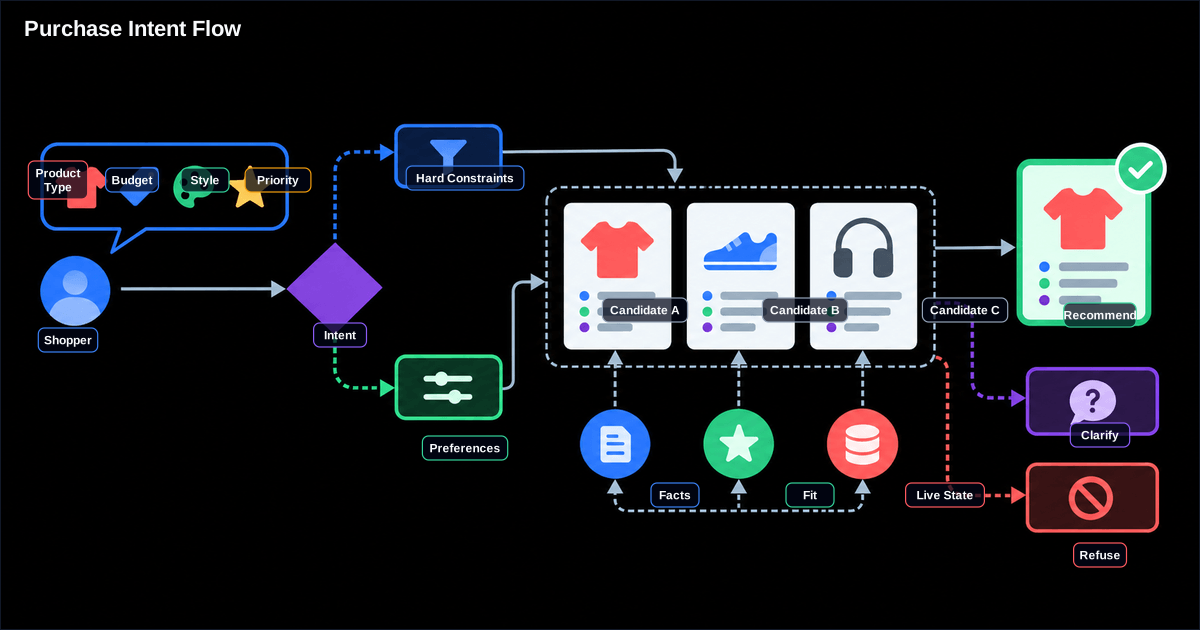
“Help me choose” is not a product query. It is an invitation to discover the missing question. A safe shopping Agent converts that invitation into explicit constraints, compares candidates on evidence, and knows when the evidence is too weak to recommend anything.
Intent is a working hypothesis
Consider “I need headphones for work.” The request omits environment, device, microphone needs, hearing constraints, budget, and tolerance for isolation. The Agent should not turn the first plausible interpretation into a recommendation. It should form a hypothesis, expose the variables that could change the answer, and ask only the questions with decision value.
Hard constraints remove candidates: connector type, allergy, dimensions, supported voltage, or a strict budget ceiling. Soft preferences rank remaining candidates: color, weight, style, or battery preference. Keeping those categories separate prevents a popular feature from overriding a safety or compatibility requirement.
Candidate facts must be comparable
Matching fails when one product describes dimensions, another uses a marketing adjective, and a third omits the field. A knowledge layer helps by presenting stable facts, guidance, limitations, compatibility, and identifiers in repeatable sections. It does not invent a universal score; it gives the Agent comparable evidence.
Unknown values remain unknown. “No limitation listed” is not equivalent to “no limitation exists.” The Agent can lower confidence, exclude the candidate for a critical constraint, or ask the merchant or shopper for more information.
Sources preserve the reason for a match
A recommendation should be reconstructable as a short chain: shopper constraint, matching claim, public source, and any live check still required. Source retention matters when two documents disagree or when a merchant updates a claim. Without it, a fluent explanation can hide a broken match.
For each decisive claim, record the resource URL and the date or version checked. If the recommendation uses compatibility information from a support page and dimensions from the product page, preserve both rather than collapsing them into an unattributed summary.
Limitations can veto the recommendation
Positive features are ranking signals. Limitations are often gates. A tent described as lightweight may still be inappropriate for winter conditions; a charger with the right power may still lack the required connector; a skincare product may contain an excluded ingredient. Once a limitation conflicts with a hard constraint, extra selling points should not rescue the candidate.
This is why “who it is not for” belongs beside benefits. It gives the Agent permission to refuse a superficially attractive match.
Recommendation, question, or refusal
The final action has three legitimate forms. Recommend when decisive constraints are supported and no known limitation conflicts. Ask a clarifying question when one answer would separate the leading candidates. Refuse when a critical fact is unavailable, evidence conflicts, or the request requires professional judgment outside the product evidence.
| State | Agent response |
|---|---|
| Evidence covers hard constraints | qualified recommendation with sources |
| One missing fact changes the winner | focused follow-up question |
| Critical evidence is absent or contradictory | refusal or safe handoff |
Test the reasoning path
Create a small set of requests with expected constraints and known traps. Run the same requests repeatedly, inspect which sources were used, and score whether the Agent rejected incompatible products. A useful test records failures as carefully as successes; otherwise the evaluation rewards confident prose instead of reliable matching.
Intent is a set of constraints, not a search phrase
“Help me choose a desk lamp” contains almost no selection criteria. “Help me choose a desk lamp for video calls in a small room, with no visible flicker and a clamp that fits a 45 mm desk” contains a use case, environmental constraint, performance requirement, and compatibility threshold. An agent should preserve those distinctions instead of compressing the sentence into a bag of keywords.
Some constraints are hard filters: a 45 mm clamp must physically fit. Others are preferences: warm color temperature may be desirable but negotiable. Some are uncertain until clarified: “small” may refer to the room, the desk, or the lamp. The agent should mark each constraint with its interpretation and confidence, ask a question when ambiguity changes the outcome, and avoid treating an absent fact as a match.
Candidate matching needs negative evidence
Suppose two lamps both mention video calls. One has a clamp range of 10–50 mm and a documented low-flicker mode. The other fits only 10–35 mm but has stronger promotional language. A keyword retriever may rank the second higher; a constraint-aware process must exclude it. Limitations and compatibility statements are therefore first-class inputs, not optional copy added after ranking.
The explanation should show which facts satisfied which constraints and cite the source for each decisive statement. If no candidate satisfies all hard constraints, the agent should say so. It may offer a near match only after naming the unmet condition. That behavior is more useful than manufacturing certainty from incomplete catalog data.
Build a reproducible decision trace
A trace can be compact: normalized intent, candidate set, evidence retrieved, filters applied, scores for soft preferences, conflicts, final decision, and live checks still required. The trace helps a merchant diagnose whether a poor recommendation came from missing product knowledge, a parsing error, retrieval, or the decision policy.
Personal data should be minimized. A product-matching trace rarely needs a shopper’s name, email, or full conversation history. Store the bounded constraints required to reproduce the result and redact unrelated content. Before purchase, hand product and variant identity to the commerce system for current price, inventory, shipping, tax, payment, and order state.
Clarification is part of matching
An agent should ask the smallest question that changes the candidate set. If every available lamp fits a 45 mm desk, asking about desk thickness adds no value; if only one does, the question is decisive. The same principle applies to size, region, intended user, existing equipment, allergies, and safety constraints. Good clarification reduces uncertainty without turning shopping into a form.
The merchant can test this behavior with paired prompts: one underspecified and one containing the missing constraint. Expected results should define whether the consumer asks, refuses, or recommends. That makes conversational quality observable and prevents the system from treating a confident guess as successful intent understanding.
Resolve conflicts without hiding them
Product sources may disagree. A product page may list one dimension while a downloadable manual lists another, or a group-level description may conflict with a variant table. The consumer should preserve both sources, prefer the authority defined by the merchant when that rule is explicit, and otherwise stop the affected match. Silently selecting the value that best fits the request turns uncertainty into bias. The trace should identify the conflict and the exact recommendation it prevented, giving the merchant a concrete correction task.