Why “Who This Product Is Not For” Can Matter More Than Selling Points
v1.0.0 features
Paired recommendation cases showing how explicit limitations protect customers, improve qualification, and make an agent’s refusal explainable.
Status: This article reflects the current v1.0.0-beta boundary. It reports a method and its evidence requirements, not unverified adoption, ranking, citation, recommendation, or sales outcomes.
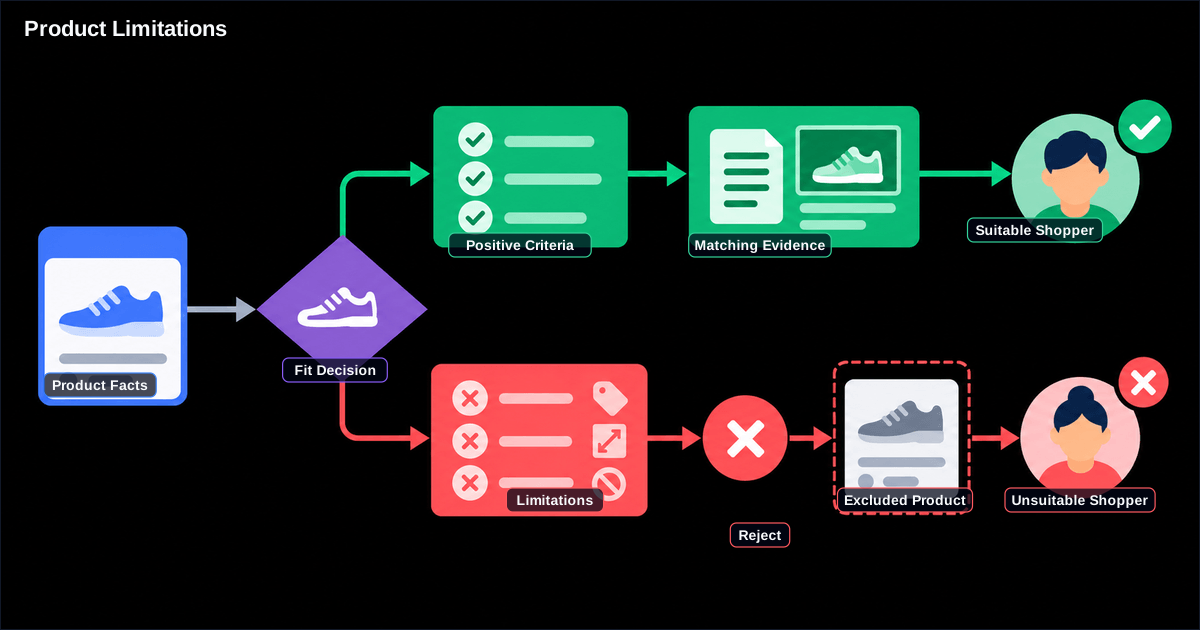
Selling points help a product enter the candidate set. Limitations decide whether it should stay there. For a shopping Agent, one explicit “not suitable for” statement can carry more decision value than five broad benefits.
Two recommendations from the same facts
Imagine a lightweight trail shoe. Its low weight, ventilation, and flexible sole make it attractive for warm, dry day hikes. The same design may be inappropriate for winter traction, ankle support, or prolonged wet conditions. A feature-only record produces a confident recommendation in both scenarios; a record with limitations separates them.
The better answer does not attack the product. It identifies the conditions under which the product’s strengths stop serving the shopper’s goal.
Limitations are not disclaimers
A buried legal disclaimer is written to reduce liability. A useful limitation is written to improve a decision. It names the affected user or condition, the practical consequence, and the evidence. “Not waterproof” is clearer when paired with the use case it affects and the official material or care source.
Avoid vague language such as “may not suit everyone.” It cannot be matched to a shopper constraint.
Positive and negative evidence have different roles
Benefits rank candidates that already satisfy hard constraints. Limitations can veto a candidate before ranking. This order prevents popularity, margin, or the number of positive claims from overwhelming a safety or compatibility conflict.
Unknown is a third state. Absence of a limitation does not prove suitability. For high-consequence constraints, missing evidence should lead to a question or refusal.
Write limitations that an Agent can use
Each item should contain one decision: the product, the excluded condition, and the reason. Keep it specific enough to compare, but do not turn medical, legal, or safety guidance into unsupported advice. Link to the product manual, material specification, size guide, compatibility list, or official policy that supports the statement.
| Weak wording | Decision-ready wording |
|---|---|
| Not for everyone | Not designed for sub-zero or icy trail conditions |
| Check compatibility | Requires a device with the specified connector and power profile |
| Consult details | Maximum supported dimensions are stated in the size guide |
Test with paired cases
For every important limitation, create one shopper request that should pass and one that should fail. Keep the product facts constant. Verify that the limitation changes the decision and that the explanation cites the right source.
This paired test is more revealing than asking whether the Agent can repeat the limitation. It checks whether knowledge changes behavior.
Merchant review question
Ask product, support, and returns teams which mismatches repeatedly surprise customers. Those cases are strong candidates for explicit limitations. Review them for accuracy and tone, then publish only claims the store can support publicly.
Positive features create candidates; limitations make decisions
Imagine a lightweight two-person tent. Its low packed weight and compact poles make it attractive for backpacking. A shopper, however, needs a shelter for exposed winter conditions and is 195 cm tall. If the product knowledge contains only selling points, a retriever may rank the tent highly. If it also states that the model is designed for three-season use and gives the inner length, the agent can exclude it for this request.
The limitation has more decision value than another adjective about portability. It defines the boundary of safe or satisfactory use. Compatibility limits, environmental limits, care requirements, contraindications, and variant-specific exceptions all help an agent avoid a plausible but wrong recommendation.
Write limitations so a consumer can apply them
“Not for everyone” is too vague. A useful limitation names the condition and scope: “not designed for sustained snow load,” “requires a 60 mm mounting clearance,” or “the straw lid is not leakproof when inverted.” It should identify the affected variant when necessary and cite the same public evidence standard used for positive facts.
Avoid turning a preference into a prohibition. “Some users may prefer a firmer mattress” is different from a documented weight limit. Likewise, do not invent safety language from reviews or absence of testing. The statement’s strength must follow the source, and uncertainty should remain visible.
Compare two recommendation traces
In a positive-only trace, the system retrieves candidates, counts matching benefits, and chooses the highest score. In a bounded trace, it first applies hard constraints and limitations, records every exclusion, then ranks the remaining candidates by soft preference. If none remain, it refuses or asks whether the shopper can relax a named constraint.
Evaluate both traces on false-positive recommendations, unsupported claims, appropriate refusals, and explanation quality. A lower recommendation rate can be an improvement when the omitted recommendations were unsafe or incompatible. Merchants should review exclusion logs too: a frequently triggered limitation may reveal unclear documentation, an overly broad statement, or a product gap.
Limitations require editorial care
The strongest limitation is specific enough to act on and narrow enough to remain true. State the condition, affected model or variant, consequence, and source. Separate a manufacturer prohibition from a merchant recommendation and a reviewer preference. If evidence changes, update the statement and preserve the earlier revision so decisions made from it can be audited.
Placement matters too. A limitation hidden only in a long FAQ may be technically public yet unlikely to survive retrieval. SKU.md gives it a named section and source relationship, but the consumer must still treat the document as untrusted merchant data and compare conflicts with other authoritative sources.
Use counterfactual questions in review
For each positive recommendation question, write a nearby case that should be excluded: same use case with an incompatible connector, higher load, different climate, allergy, or variant. The pair reveals whether the system applies boundaries or merely recognizes category words. Reviewers should be able to point to the exact limitation that changed the outcome.
This practice also improves content. If editors cannot construct a meaningful negative case, the limitation may be too vague. If almost every candidate is excluded, its scope may be too broad or the catalog may genuinely lack an appropriate option. Both findings are useful, and neither requires a claim about sales uplift.
Limitations can also improve comparisons between two otherwise similar products. One product may be lighter but unsuitable for heavy rain; another may be heavier but tested for that environment. The agent should not label either universally better. It should connect the shopper’s stated conditions to the relevant boundary, present the trade-off, and preserve the source. This turns a negative statement into decision information rather than a reason to suppress the product.
The final answer should keep positive and negative evidence in balance. A limitation does not erase the product’s strengths; it determines the conditions under which those strengths are relevant. Explanations can say that a candidate is well suited to one use but excluded from the present request because of a named boundary. This wording helps shoppers understand the decision, helps merchants see whether the boundary is accurate, and avoids turning honest limitations into punitive ranking signals.