Platform perspectives
BigCommerce and SKU.md: Source-Backed Product Knowledge Across Channels
How BigCommerce merchants can preserve product conditions and public sources across channels, then test SKU.md with one well-documented product.
Suppose a docking station is described as “dual-display compatible” in the brand store. A marketplace card shortens that to “multiport expansion,” while an older manual lists different limits for different operating systems. When a shopper asks whether a laptop can run two independent displays, the brand has to recover the model, port, and system conditions before it can answer reliably.
Multichannel selling puts products in more places, but it also gives the same product knowledge several forms. Merchants need to maintain more than the fields sent to each channel. They need an explanation of when a claim applies and a public source that a shopper or editor can check.
Distribution does not remove the merchant’s editorial role
BigCommerce discusses channel and AI-shopping capabilities in its overview of agentic commerce platforms. Each destination can have its own data requirements, layouts, and purchase flow. Merchants still have to prepare accurate attributes and descriptions, then inspect how essential conditions survive when the content is shortened or rearranged.
SKU.md sits on the merchant-published side of that relationship. It is an independent, experimental 1.0.0-beta proposal for a catalog entry point and optional source-backed product knowledge. It does not synchronize product copy across channels, repair a marketplace listing, or show that BigCommerce has adopted the proposal.
A useful pilot has a narrower aim. Someone reading a product explanation should be able to identify which item it covers, understand its conditions, and follow the source. Each channel remains responsible for how it displays an attribute and conducts a purchase.
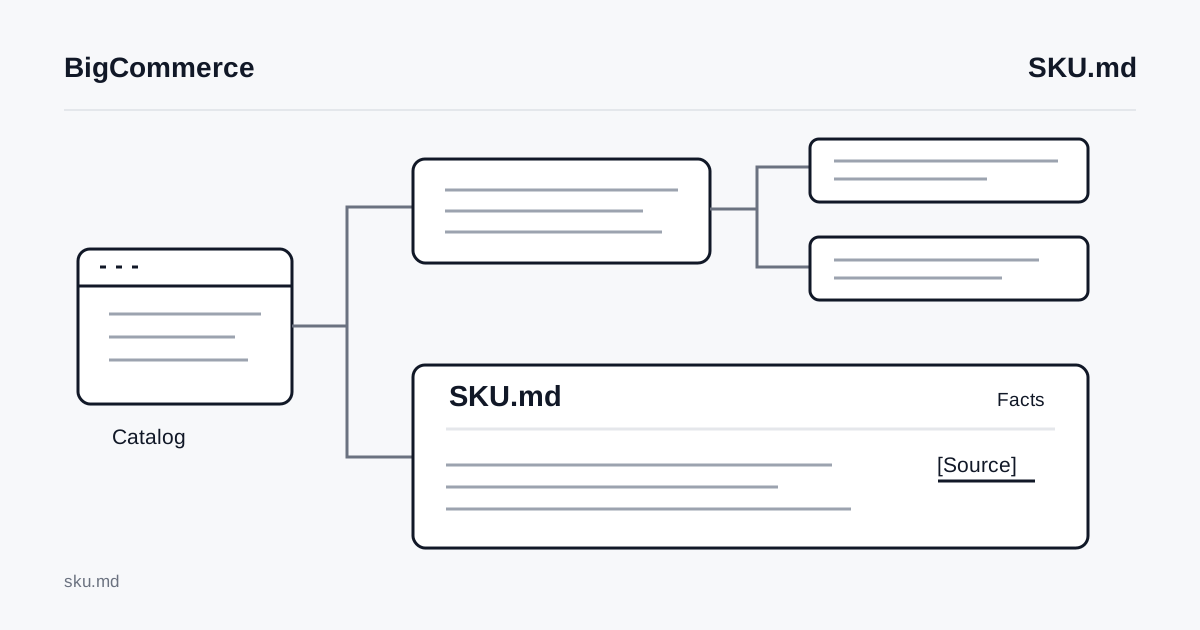
Product explanations should preserve buying conditions
“Supports two displays” can mean different things on different computers. Repeating the shortest marketing line removes the condition that decides whether the product works for a shopper. A product knowledge entry can begin with one precise question and keep the compatibility details beside their source.
Someone who knows the product should verify the technical boundary before an editor makes the answer readable. Every fact, compatibility condition, and limitation in an optional product knowledge document needs a Source link. A specification for one model should not be transferred to another because the products share a family name.
The same source-backed explanation can help a team spot weak channel copy. When a channel has omitted a critical condition, the merchant must correct it through the existing product content and distribution workflow. The public knowledge file supplies a reference point. It cannot access channel administration or update a third-party listing.
A brand selling both retail and wholesale should also decide which material belongs in public. General specifications may be useful to everyone; customer-specific quotes, contract attachments, and partner-only documents should not be copied into a public file. Establish the public source set first, so readers can inspect the supporting facts without logging in. Specific commercial terms remain in the relevant channel.
Pilot with the product that has the best documentation
Select an item with an unambiguous identity, a public manual, and a complete compatibility guide. Use the current specification to create a minimal brand catalog. Then decide whether the item is ready for an optional Product knowledge document. The catalog makes the material discoverable; the product document explains; public sources support the claims.
Starting with a well-documented product keeps the editorial question visible. Which conditions matter? Does each source support the wording? Could two variants be confused? If the first item still has disputed specifications, settle the public product page and manual before expanding coverage.
Price, availability, shipping, tax, and order progress do not belong in static knowledge. BigCommerce and the relevant live commerce services continue to answer those questions. Carts, checkout, and payment retain their existing authority. A quote presented in one channel at one moment needs to be confirmed in that channel or its connected live system.
SKU.md therefore complements the merchant’s content practice. It neither replaces the catalog nor creates a new master system for multichannel operations. One product is enough to find out whether the team can publish a clear explanation and keep its sources intact.
Choose the route that matches Stencil or a headless storefront
BigCommerce’s storefront documentation distinguishes Stencil, Catalyst, and custom headless storefronts. A merchant running Catalyst or another merchant-hosted storefront can ask the team responsible for routing to provide /sku.md on the same origin. That team can publish the generated catalog as plain Markdown and inspect the public address with the published URL validator.
Catalyst uses Next.js, whose Route Handlers can return non-HTML content from merchant-controlled hosting. A direct 200 is recommended because it gives the clearest response. The current specification also permits up to three bounded safe redirects. Locale middleware or a general page fallback should not turn the root file into an HTML page or move it to a different destination without being checked.
Stencil merchants have a different boundary. BigCommerce’s custom templates apply to existing Brand, Category, Product, and Page HTML surfaces. They do not provide an arbitrary root Markdown response. Improve the existing product information first, and do not replatform solely for SKU.md.
The BigCommerce platform guide helps a site team choose between these routes. After publication, check that the catalog and product document refer to each other correctly, the sources remain accessible, and the current file has reached the public cache. A file committed to a storefront project is not proof that the shopper-facing domain serves it.
Let the pilot reveal gaps in channel content
The result can be modest and still useful. A team may restore a compatibility condition that disappeared from channel copy, replace a link to an old manual, or decide who reviews a specification after it changes. Folding those actions into the product update workflow is more sustainable than generating an entire catalog without an editor.
Google’s guidance for AI features in Search states that special AI Markdown files neither help nor hurt Google visibility or rankings. Accessible HTML, accurate content, and established SEO work remain important. Publishing a conforming file does not establish that a model reads or cites it.
For two different storefront models, read Shopify’s merchant-owned knowledge approach and WooCommerce’s way of reconnecting scattered material. Choose one product with dependable sources, then open the BigCommerce generator and build the catalog around what the brand can verify.