What GEO and AEO Mean for Independent Stores: What You Can Measure and What You Cannot Promise
v1.0.0 features
A measurement framework that separates observable discovery and answer quality from unsupported promises about rankings, citations, or recommendations.
Status: This article reflects the current v1.0.0-beta boundary. It reports a method and its evidence requirements, not unverified adoption, ranking, citation, recommendation, or sales outcomes.
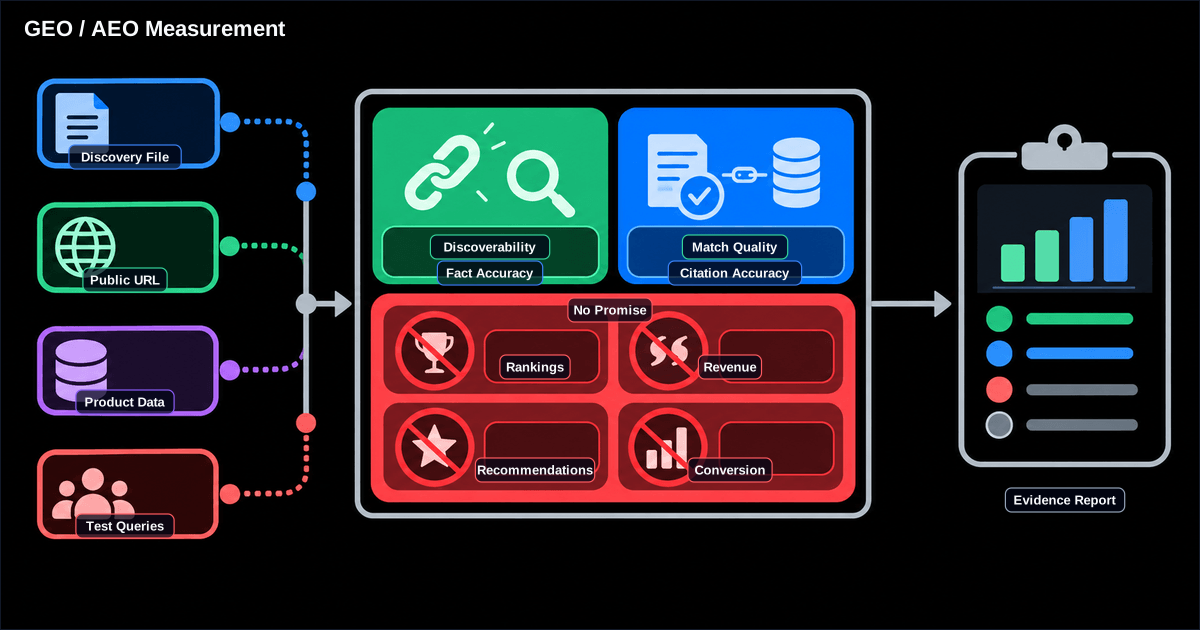
GEO and AEO are useful labels only when they lead to an observable question. For an independent store, the productive question is not “did we optimize for AI?” It is “can a defined consumer discover, retrieve, understand, and source the product knowledge we published?”
Start with a measurement chain
Separate the chain into discovery, retrieval, interpretation, answer construction, and downstream action. A failure at discovery means the resource was never reached. A retrieval failure means the wrong document was selected. An interpretation failure means the document was read but a field or limitation was misunderstood. Each requires a different correction.
Do not combine the chain into one visibility score. A single number hides where the system failed and encourages unsupported causal claims.
What the store can measure directly
The store can verify HTTP availability, response type, redirects, document validity, source links, and whether a controlled consumer finds the intended catalog. It can run fixed questions against a fixed corpus and score factual accuracy, source accuracy, refusal quality, and compatibility errors.
Server logs may show requests from identifiable clients, and analytics may show referrals. Those observations are useful records. They do not, by themselves, reveal whether a file caused a citation or recommendation inside a model.
What cannot be promised
No publisher controls a third-party model’s ranking, training, citation policy, recommendation logic, or product availability. Search providers can also change crawling and answer features without adopting a particular community file. A standard can improve the quality of an input for consumers that choose to use it; it cannot promise the output of consumers that do not.
That boundary should appear in proposals and reports. Avoid translating a successful fetch into “AI visibility,” a single cited answer into “adoption,” or a referral increase into sales causation.
A measurement matrix
| Question | Observable evidence | Unsupported leap |
|---|---|---|
| Can the resource be discovered? | repeatable fetch and discovery trace | all models will use it |
| Can facts be retrieved correctly? | labeled test questions and expected facts | ranking will improve |
| Are answers sourced? | preserved URLs and source scoring | the publisher will be cited publicly |
| Do users arrive or convert? | analytics with defined attribution limits | the file caused revenue |
Design an experiment another person can inspect
Record the date, document version, model or consumer version, prompt, retrieval budget, expected answer, observed answer, and sources. Keep the baseline and intervention conditions identical except for access to SKU.md. Blind reviewers to the condition where possible.
Publish failed questions and ambiguous cases. A result that cannot be reproduced by another person is an anecdote, even if it is encouraging.
A reporting language that stays credible
Use precise verbs: “was reachable,” “was selected,” “matched the expected fact,” “preserved the source,” or “referred a visit.” State the observation window and sample size. Reserve claims about rankings, citations, recommendations, adoption, and conversion for evidence that measures those outcomes directly and survives alternative explanations.
The useful business decision
An independent store does not need to wait for a universal GEO metric. It can decide whether the knowledge file reduces extraction errors, improves compatibility checks, and makes its own claims easier to audit. Those gains are operational and measurable even when third-party visibility remains uncertain.
Start with a measurement chain you can observe
For an independent store, the observable chain begins with publication: does the intended URL return the intended bytes? Discovery follows: can a declared consumer locate the catalog without guessing? Retrieval asks whether the correct product document appears for a fixed question. Grounding asks whether the answer uses supported facts and preserves source URLs. Suitability asks whether hard constraints and limitations were applied correctly. Each stage can be tested with controlled inputs.
This chain does not prove how a proprietary search or answer engine will rank the store. It measures the store-controlled surface and the behavior of named consumers under a documented procedure. That narrower claim is still valuable because failures are actionable: fix a route, a source, a missing limitation, or a matching rule.
Use a matrix instead of one “visibility” number
Track publication success, discovery success, correct-document recall, factual accuracy, source accuracy, incompatible-candidate rejection, and live-state handoff separately. A combined score can hide a serious defect. For example, high retrieval with poor source preservation produces fluent answers that are difficult to audit; high factual accuracy with low recall leaves many valid products undiscovered.
Segment results by question type, product category, locale, and consumer version. Record the document revision and test date. If a metric changes after an update, the merchant can then distinguish better content from a different model, index, or evaluation sample. Without those controls, a chart may look precise while answering no stable question.
Claims that evidence cannot support
A controlled test cannot guarantee a ranking position, inclusion in a proprietary answer, a citation, a recommendation, or a conversion. Those outcomes depend on systems and decisions outside the file: engine policies, model versions, competition, user context, inventory, price, and checkout. Even an observed referral does not by itself establish causation.
Reporting should therefore pair every metric with its scope. “The reference consumer discovered 98 of 100 documents in this fixture set” is testable. “SKU.md improves GEO” is too broad unless the speaker defines the engine, query set, baseline, time period, and causal method. Honest measurement makes the work more credible and shows where further experiments are needed.
Design an experiment that can be rerun
Publish the query set, expected document or refusal, consumer version, retrieval limits, scoring rules, and raw outputs. Run a baseline against the same public pages and a treatment with SKU.md available. Keep the sample and budgets equal. When a store changes content, preserve the old snapshot so later runs do not rewrite history.
For ongoing operations, use a small stable regression set after each publication and a larger periodic evaluation. The regression set catches broken routes, sources, and high-value constraints quickly. The larger set measures broader coverage. Neither should be presented as proof about engines that were not tested.
Establish a baseline before publication
Measure the same questions against the existing store before introducing SKU.md. Preserve the product pages, structured data, retrieval settings, and outputs used in that baseline. After publication, change only the availability of the knowledge documents where possible. This does not make a local experiment universal, but it prevents a before-and-after story from confusing simultaneous catalog, model, or campaign changes with the effect being studied.
A useful reporting cadence separates operational monitoring from research claims. Route and validation checks can run after every publication. Matching evaluations can run on a scheduled sample. Claims about external engines require a separate study using that named engine and period. Keeping these reports separate prevents a broken URL from being discussed as a marketing trend, or a short-lived referral spike from being described as durable retrieval quality.