What llms.txt Can Teach SKU.md About Open Standard Adoption
v1.0.0 features
An ecosystem analysis of why a small convention needs a predictable default, standard discovery, useful tools, independent implementations, and restrained claims.
Status: This article reflects the current v1.0.0-beta boundary. It reports a method and its evidence requirements, not unverified adoption, ranking, citation, recommendation, or sales outcomes.
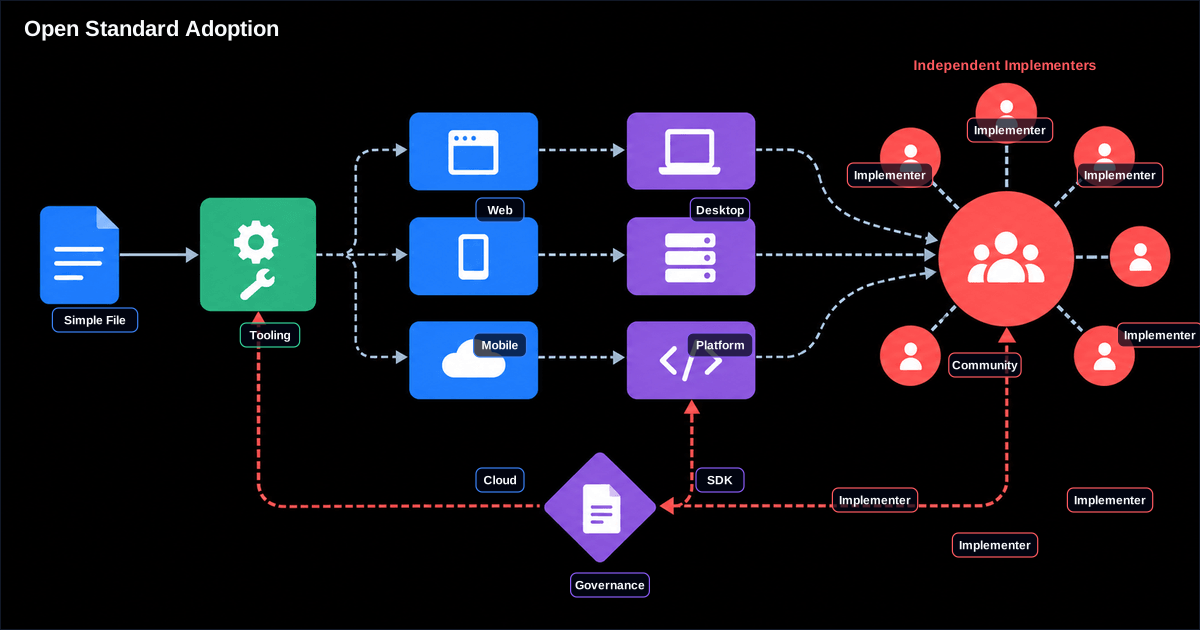
An open standard is adopted through accumulated implementation decisions, not through a launch announcement. llms.txt offers SKU.md a useful case study because its appeal begins with a simple file and a predictable location, while its ecosystem depends on tools, integrations, documentation, and independent experiments.
Simplicity creates the first implementation
A plain text or Markdown resource at a memorable path is easy to inspect with a browser or command-line client. That lowers the cost of a first prototype and makes failures visible. SKU.md should preserve the same property: a merchant can read what it publishes and a consumer can fetch it without a proprietary SDK.
Simplicity does not remove the need for a contract. Discovery precedence, media types, redirects, origin checks, required fields, and error behavior must still be deterministic.
Tools turn a convention into a workflow
Editors need a generator and validator. Developers need parsers, a normalized output, fixtures, and useful diagnostics. Platforms need bounded publication patterns. Without these pieces, every implementer interprets the file differently and the apparent simplicity becomes hidden integration cost.
Tool output should point back to the normative rule and preserve source locations so errors can be repaired rather than merely reported.
Integration evidence is stronger than logo lists
One public, repeatable integration teaches more than a page of unsupported platform names. Record the route, response, limitations, and maintenance owner. If a platform requires compatibility discovery instead of a root file, describe that difference rather than presenting both as identical support.
Independent implementations provide the next level of evidence. Conformance tests let them demonstrate compatible behavior without relying on project affiliation.
Community feedback needs a governance path
Implementers will find ambiguous rules, missing fixtures, scale limits, and security problems. A useful standard explains where to report them, how changes are proposed, and which changes require a new version. Stable behavior should not shift through undocumented examples.
Adoption grows when contributors can improve tooling and test vectors without losing the core boundary.
Lessons SKU.md should apply
| Lesson | Practical application |
|---|---|
| Keep the first fetch simple | preferred /sku.md path and readable Markdown |
| Standardize discovery | explicit precedence and safe alternate declaration |
| Ship tools with the text | validator, SDKs, CLI, fixtures, diagnostics |
| Prove integrations | public PoCs with limitations and repeatable evidence |
| Welcome independent work | conformance kit and stable AST |
| Govern changes | RFCs, versioning, changelog, release gates |
What not to copy blindly
SKU.md describes products, so stale commerce data and product identity conflicts create risks that a general site index may not have. It needs stronger source provenance, identifier rules, live-state handoffs, and recommendation limits. The lesson is to reuse the adoption pattern while keeping the domain contract precise.
Near-term action
Publish small interoperable artifacts, invite independent parsers, and measure where implementations disagree. A healthy ecosystem is visible in compatible tools and documented constraints, not in speculative claims about how many models may consume the file.
A simple file is only the entry point
The attraction of llms.txt is easy to understand: a memorable default path and readable text let publishers experiment without negotiating a large API. That simplicity reduces the cost of producing an example, writing a parser, and discussing the idea. Yet a path alone does not create interoperability. Consumers still need rules for discovery, content, errors, redirects, security, versions, and conflicts.
SKU.md should keep the same low-friction starting point while being precise about its narrower domain. A merchant publishes product knowledge; a consumer can discover, validate, parse, and trace it. The format must remain understandable in a text editor, but independent tools need a normalized contract and conformance cases so “simple” does not become ambiguous.
Adoption grows through boring tools
Standards become usable when ordinary work is inexpensive. That requires examples, generators, validators, SDKs, fixtures, migration notes, platform recipes, and diagnostics that tell a merchant what to fix. A polished announcement cannot replace those pieces. Neither can a repository badge that counts interest without showing compatible implementations.
Platform integrations matter because merchants rarely control every route and header. Each recipe should state its tested configuration and limitations. Community implementations matter because they reveal assumptions hidden in the reference code. Their disagreements should become tests or specification decisions, not competing undocumented dialects.
Measure ecosystem evidence conservatively
Useful evidence includes independent parsers passing the same fixtures, merchants publishing valid public documents, platforms documenting a supported path, and reproducible consumer experiments. Downloads, stars, mentions, and visits may describe attention, but they do not prove conformance or business impact.
Governance should make changes visible: versioned decisions, a public issue process, backward-compatibility rules, and a clear way to contribute failing cases. The lesson is to make the smallest useful contract easy to try, then grow confidence through tools and independent evidence. SKU.md should not claim that another project’s visibility guarantees its own adoption.
Defaults reduce coordination cost, not the need for a contract
A memorable URL lets two parties meet without prior negotiation. The rest of the behavior still needs specification: what a successful response looks like, which links are authoritative, how versions change, and how failures appear. SKU.md can use a root default while also defining standards-based discovery for hosted platforms. Multiple discovery options need a deterministic order so flexibility does not create ambiguity.
The publication format and parser contract should also remain distinct. Markdown is what a merchant reviews and serves. A normalized AST is what tools compare. This arrangement supports human governance and machine determinism without asking merchants to maintain parallel Markdown and JSON sources of truth.
Make independent implementation the adoption test
The reference implementation is evidence only when another implementation can reproduce its results. Conformance fixtures should include valid, invalid, conflicting, versioned, and security-sensitive cases, with expected normalized values and diagnostics. A third party should be able to run them without contacting the original authors.
Platform recipes need the same discipline. Name the plan, configuration, route, headers, and limitations that were tested. When platforms change, rerun the recipe and date the result. This creates an ecosystem of verifiable compatibility rather than a list of logos.
Documentation should include a first successful example and the first likely failure. Showing only the happy path teaches publishers to recognize syntax, but not to diagnose an HTML fallback, conflicting discovery link, unsupported version, or unsafe redirect. Small, specific diagnostics reduce support cost and make implementations converge on the same behavior. That practical consistency matters more than how quickly a proposal accumulates mentions.
A standard also needs restraint. Every requested feature should be tested against the core problem and maintenance cost. Optional extensions are safer when they cannot change the meaning of required fields or discovery. Large schemas, duplicated live data, and platform-specific shortcuts can increase apparent capability while reducing the chance that two independent tools agree. Stable adoption is more likely when the contract stays small, errors are explicit, and later changes follow an open versioned process.